Zelenka's votive mass (ZWV 18), actually called Mass of Resurection, was (brilliantly) plaid in concert on June 20 & 22, 2010 by the orchestra and choir of St-Nicolas under the direction of Vincent Lecornier.
The corresponding CD should be released as early as on July 9.
You may already listen to an extract of what is bound to be a magnificient record, considering both the quality of the repertoire and its interpretation: the orchester, the solo artists, the choir, everything is perfect, everyone transmits the joy that penetrated Zelenka when he composed this mass as a tribute for his healing.
The trainees have left some comments on the content, form and spirit of this course that has brought them together for four days. Here are some excerpts.
According to the spirit of Pius XII encyclicals "Musicae Sacrae Disciplina" and "Mediator Dei"
De Musica Sacra et Sacra Liturgia - Sacred Congregation of Rites - (September 1958)
In recent times, three documents of very great importance were published on sacred music by the Popes: the Moto Proprio of St. Pius X, Tra le sollecitudini, of November 22, 1903; Pius XI's Divini Cultus Apostolic Constitution of December 20, 1928; and finally, Pope Pius XII's Encyclique Musicae sacrae disciplina, of December 25, 1955, not to mention papal documents of lesser importance and decrees of the Sacred Congregation of Rites, which settled various issues related with sacred music.
Jan Dismas Zelenka (1679-1745) is as much of a discovery for today's
audiences as were the great Masters of Baroque music for music-lovers
in the past century.
Here are large excerpts from three hymns for Pentecost and its octave.
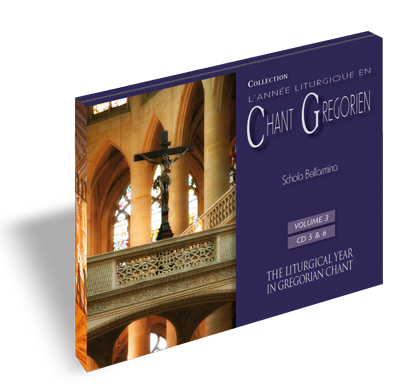
These songs, sung and harmonized by the professional ensemble Bella Carmina are part of a set of 3 discs containing 50 songs in French, among the finest. These discs are currently being produced and will be published this fall.
It is a commonplace to say that Gregorian chant experienced a decline between the twelfth and nineteenth century, and was "resurrected" through the work of Solesmes, a school which now supposedly presents Gregorian chant as it would have been or should be.
The Solesmes school itself has changed considerably during the twentieth century - which is to his credit - under the influences of both Dom Mocquereau's theory and Dom Cardine semiotics.
Yet, there is room for a certain number of questions:
Is there one single reference for the interpretation of gregorian chant?
And supposing we were able to define the performance style that prevailed at the time of the creation of the Gregorian (sixth-tenth centuries), would such a style still be valid in the twenty-first century?
Besides, who says that during such a long period of time and in such a large geographical space, a unique style would have been adopted?
Does each period of time not consider liturgical chant against its own criteria?
Don't we speak of evolution or decline in relation with those criteria and the mindset of the times?
As You may see, the question of interpretive styles in Gregorian Chant is far from resolved and we have no claim to draw definitive conclusions. The text below is taken from the work of Jacques Viret: "The Gregorian chant and Gregorian tradition" (pages 58-59, L'Age d'Homme edition) it gives the status quaestionis, the state of the question. This already enables to broaden the debate and avoid focusing on systems or theories which may be too exclusive.
Hallelujahs or allelujas date back to the late fourth century. The following centuries saw their developpment, coinciding with a period of Byzantine influence in Rome.
Originally, the Hallelujah is an hebraic acclamation. Among Jews, it was used with a score of psalms called Alleluja psalms (104 to 106, 110 to 118, 134 to 135, 145 to 150). This acclamation was initially linked with the consideration of the wonders of the Lord, which makes it a cry of joy.
A new leather-like protection has just gone on offer. It helps protect your gregorian chant book (nr 780) againt wear and other risks that such a book may endure over time.
French publisher Editions Sainte-Madeleine has just published two interesting new items, one of which had been expected for years:
the gregorian vesperal missal (formerly designated as "904"), which contains the masses and vespers for sundays and feasts, as well as the feasts of saints, together with gregorian partitions and latin vs. french texts.
And since the Holly week is now ahead of us, mention should be made of the 2009 reedition of the Holly week book containing all the offices with texts in latin and french, as well as gregorian tunes. Very helpfull to those attending Easter celebrations, be they once-in-a-year penants or regular choir members.
Those tutorials contain some basic notions of gregorian chant, together with practical applications for choir singers.
It is an interesting and, to some extent, very useful pedagogical means. Yet a limited one. There is actually no better training into gregorian chant than a vivid, face to face interaction between teacher and pupil. Training sessions are thus the best option.
Meanwhile, watching these tutorials may help you improve your knowledge of gregorian chant.